

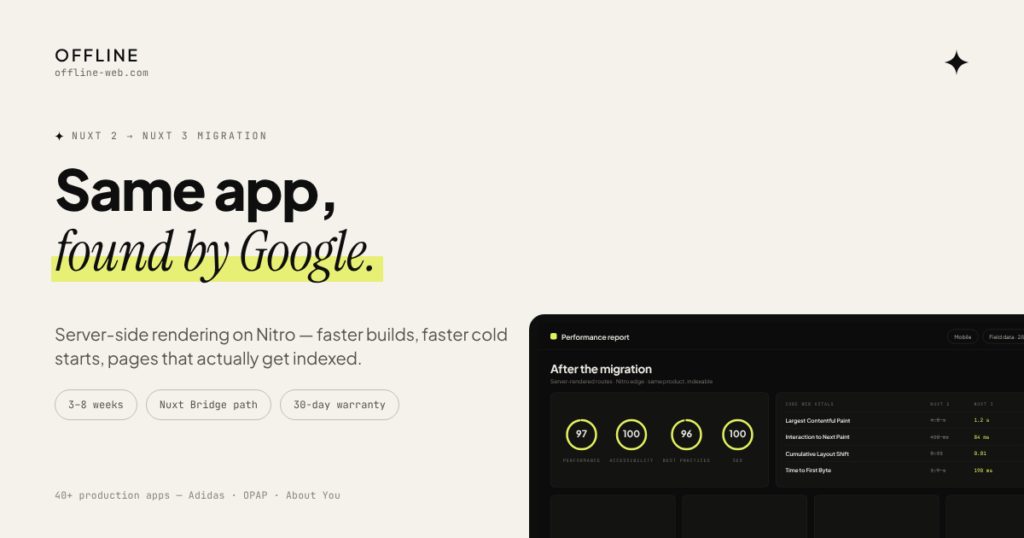
Nuxt 3 reached end of life on July 31, 2026. A Nuxt 4 migration starts with its module, rendering and deployment risks mapped before code changes. I move the application in stages around normal product delivery. I also move Vue SPAs to Nuxt when server rendering or hybrid delivery fits the product.
I work with this stack regularly. Before upgrading, I map the version changes, module replacements and rendering behavior. The plan then moves the application in reviewable stages.
The starting point changes the work. A Nuxt 2 codebase has a larger jump across modules, build tooling and application structure. A client-rendered SPA is a different case: server rendering or prerendering can improve initial delivery, link previews and crawl reliability, but it is not an automatic ranking boost.
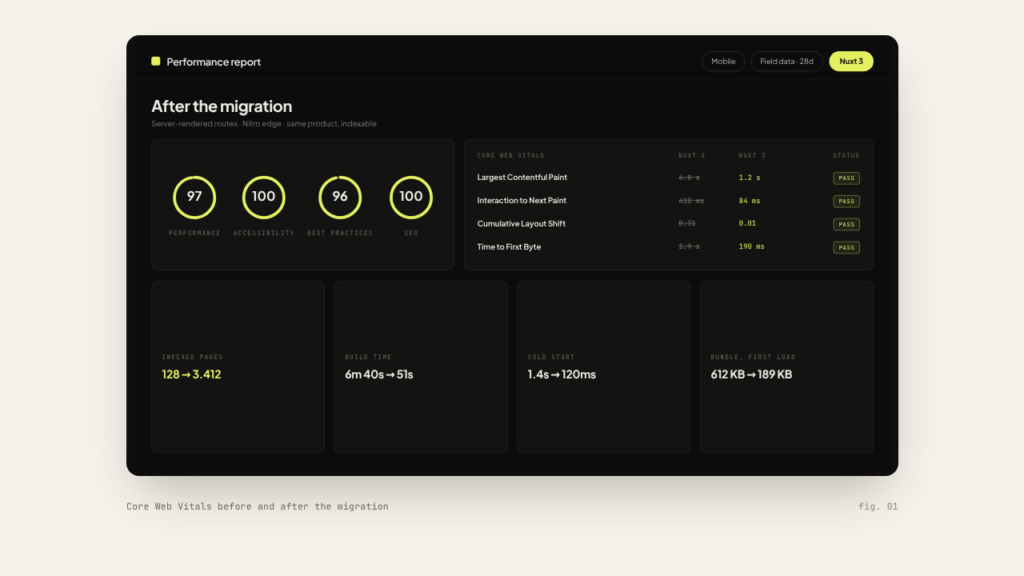
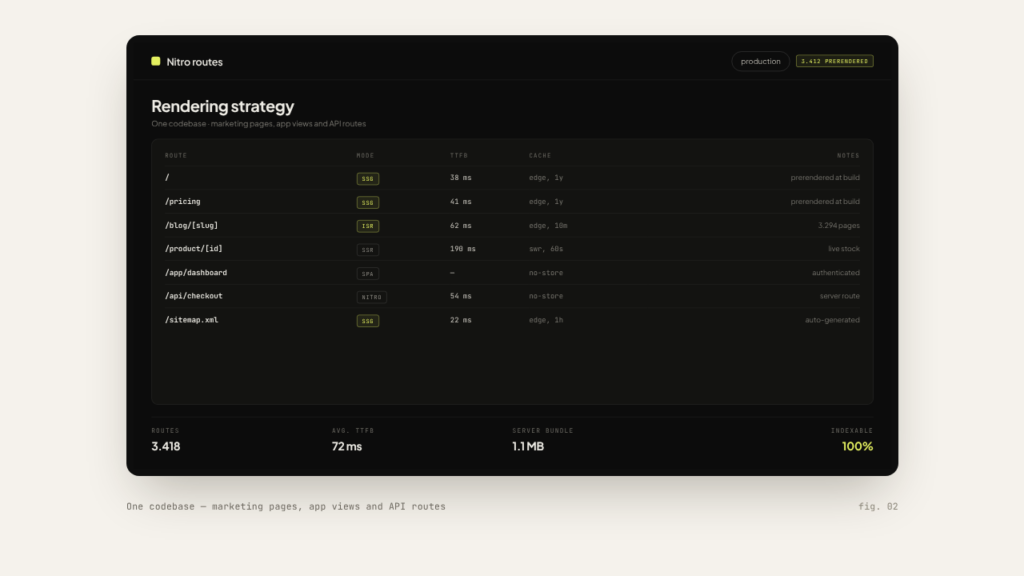
I choose SSR, prerendering or hybrid rendering route by route. That gives public pages useful HTML on the first response while keeping authenticated application views as lean as they need to be. Performance still has to be measured; the framework does not guarantee Core Web Vitals or rankings by itself.
Current server routes also give AI features a clean place for streaming, authentication and cost controls. They make the implementation easier, but streaming UI does not depend on a particular framework.
Technical Audit
Architecture & Plan
Incremental Migration
Hardening & Handover
What the migration delivers
- Faster initial delivery where rendering changes make a measurable difference (Nitro)
- Server rendering or prerendering where it improves crawl access and link previews
- A TypeScript-first codebase with documented state management
- A staged plan designed to minimize roadmap disruption during migration
The app still works. Why migrate now?
Official maintenance ended on July 31, 2026, so the previous major release no longer receives upstream security fixes or maintenance releases. Moving while the codebase is still one major version behind keeps the change smaller than waiting through another major release.
Is server rendering worth adding to our SPA?
Often, but not because Google is unable to render every SPA. Server rendering or prerendering can improve the first response, crawl reliability and link previews. I check your routes, current search visibility and performance before recommending the move.
How long does the upgrade take?
A one-major-version upgrade is usually smaller than a legacy migration, but the schedule depends on module compatibility, custom server code and test coverage. The audit turns those variables into a concrete timeline before work starts.
What happens with incompatible modules?
The audit verifies each module. Where a compatible release or documented replacement exists, I use it; where one does not, I isolate, replace or remove the module so the migration plan reflects the actual constraint.
More Services
Get in touch
Athens, Greece, working remotely with EU & US teams
info@offline-web.com