Vue 2 to Vue 3 migration

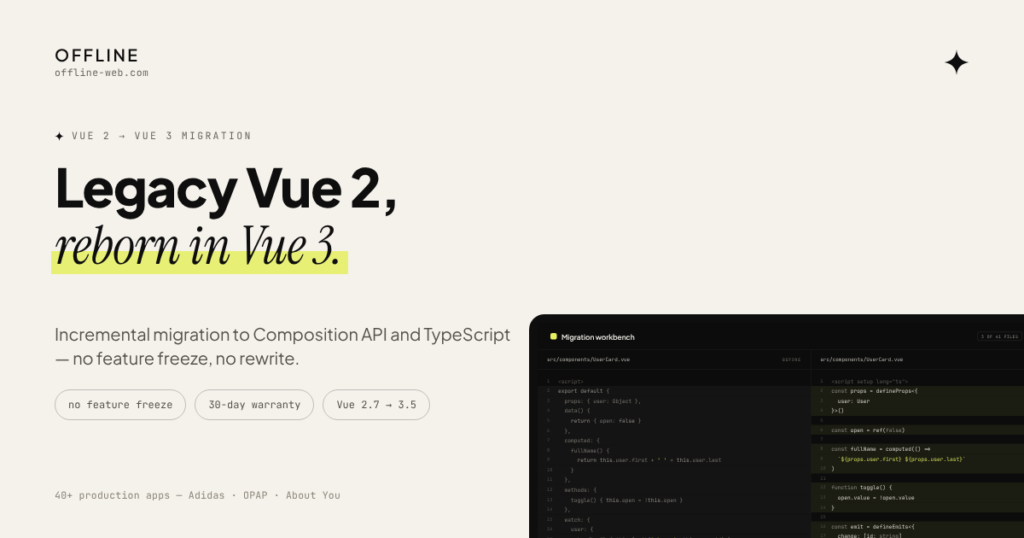
Vue 2 to Vue 3 migration — legacy Vue 2 reborn in Vue 3 with the Composition API

A Vue 2 to Vue 3 migration is worth planning when the application needs supported dependencies or must pass current security reviews. The older release reached end of life in December 2023 and no longer receives upstream security fixes. I map the dependency and library risks first, then move the application in stages around normal product delivery.

I have moved production applications from Vue 2, AngularJS and jQuery to Vue 3. One was the UI for OPAP's retail betting machines, a system the business depends on every day. I stage the work around normal delivery, with measurable milestones and a clear rollback path. Before choosing the first slice, I inventory the component tree, state layer and build chain so the plan follows the codebase's real dependencies.

Staying on an unsupported release leaves the framework frozen while libraries and build tools continue to move. Older dependencies can block safe upgrades, and security reviews may flag the stack. Workarounds also add to the later migration scope when the old codebase keeps growing. If new features continue to land on the old stack, those changes have to be assessed during the upgrade as well.

The result is a maintained frontend with current documentation and a path to upstream fixes. Every other dependency still needs its own review. I use Vite and TypeScript where they fit the codebase. If the starting point is different, see my jQuery migration service or server-rendered application migrations.

A current frontend also makes AI features, such as copilots or retrieval search, easier to add because the interface no longer has to be modernized first.

01
Technical audit
I map your codebase first: dependencies, incompatible patterns, store usage and a component inventory. You get a migration report with an effort estimate and the risk areas before any code changes.
02
Architecture & plan
I define the migration path: component strategy, state management, build tooling and TypeScript adoption. The plan sets the component order and names the risks up front.
03
Incremental migration
The migration moves in tested stages behind feature flags. The plan is designed so normal product delivery can continue where dependencies allow, with rollback points instead of a big-bang cutover.
04
Hardening & handover
A performance pass, accessibility check, documentation and team walkthrough, plus a 30-day technical warranty after go-live.

What the migration delivers

  • Current build tooling that removes legacy build constraints from feature delivery and day-to-day maintenance (Vite)
  • A documented TypeScript codebase aligned with current tooling for onboarding and maintenance
  • A staged plan designed to let normal product delivery continue where dependencies allow
  • Documentation, tests and a 30-day warranty after go-live
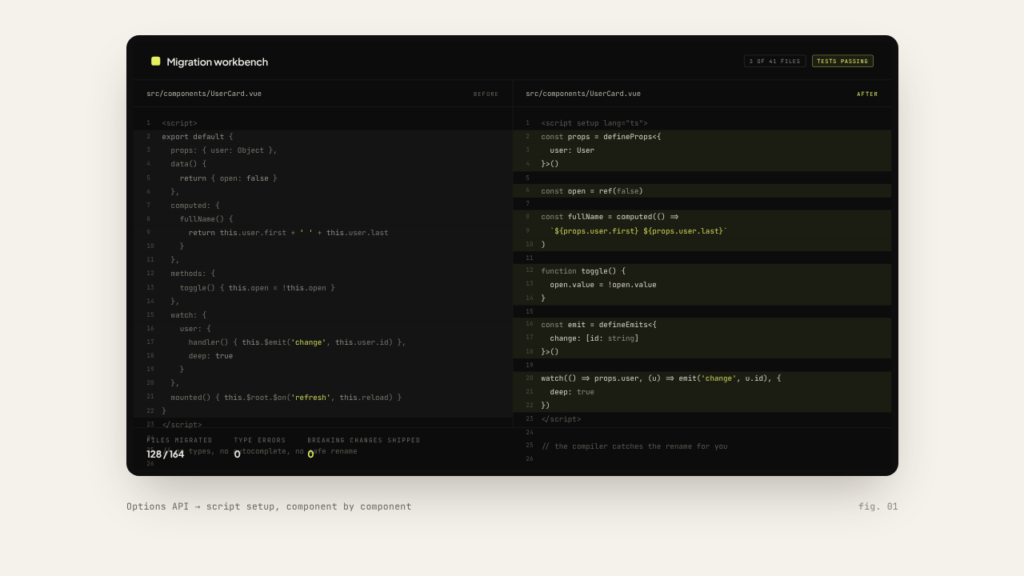
Vue 2 to Vue 3 migration: Options API rewritten as script setup with TypeScript
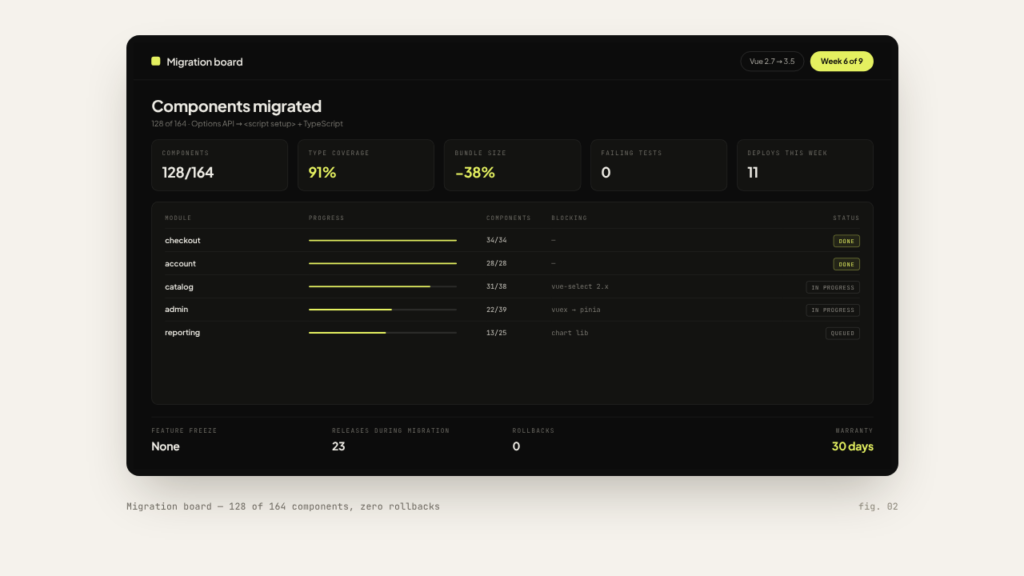
Vue 2 to Vue 3 migration board: 128 of 164 components migrated, zero rollbacks
How long does a version migration take?

The schedule depends on component count, state management, build tooling, incompatible libraries and test coverage. The technical audit maps those dependencies and gives you a concrete estimate before implementation starts.

Often, yes. The migration can run slice by slice behind feature flags, so normal product delivery can continue where dependencies allow. I plan each stage to minimize disruption and keep a clear rollback path.

The audit includes a full dependency map. Every incompatible library then gets a path: an upgrade, a maintained alternative, or a thin replacement component.

Yes. The process is the same: audit, architecture and incremental migration. I have moved AngularJS and jQuery frontends into a component-based architecture for clients across the EU and US.

Get in touch

Athens, Greece, working remotely with EU & US teams

info@offline-web.com

I reply by email
Get a price and timeline

    How it works
    1. Tell me about your project below.
    2. I'll email you a few quick questions (about 3 minutes).
    3. You get a price, timeline and project scope by email — no call.
    A link helps me scope your project faster.

    Complete the short questionnaire to receive your indicative price, timeline and scope by email.

    This site is protected by reCAPTCHA and the Google Privacy Policy and Terms of Service apply.