

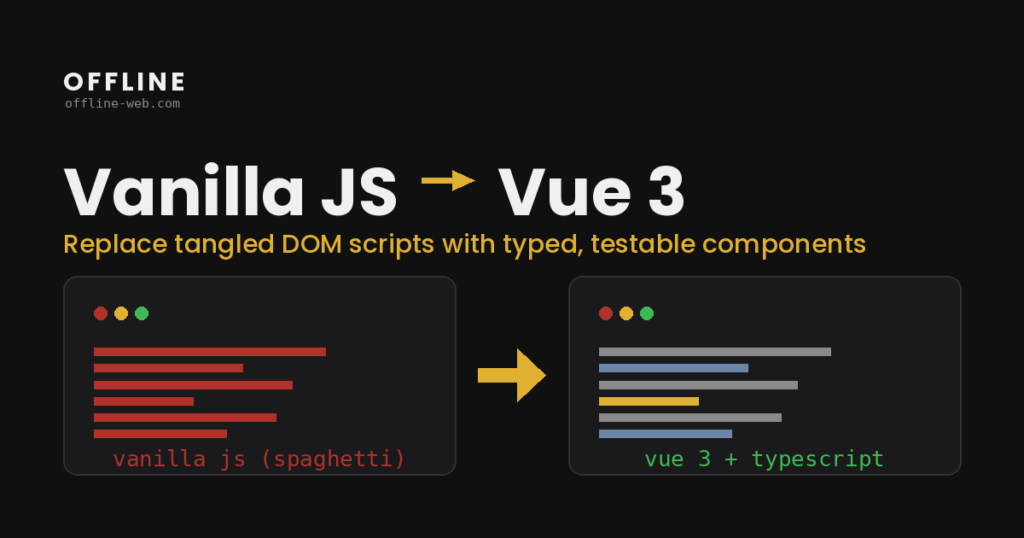
A vanilla JS to Vue migration turns a hand-rolled JavaScript frontend into a maintainable Vue 3 application. Apps built with raw DOM manipulation — getElementById, addEventListener, manual innerHTML updates — work fine until they grow: state ends up scattered across global variables, there is no single source of truth, and one small change quietly breaks something three files away. So I rebuild that vanilla JavaScript frontend into a component-based, reactive Vue 3 codebase.
Most importantly, the migration is incremental: Vue mounts inside your existing pages and takes over one widget or screen at a time, so the business never stops shipping. It is the same process I use on enterprise systems — audit first, measurable milestones, and a codebase your team can finally test, extend, and hand to a new hire without weeks of tribal-knowledge onboarding.
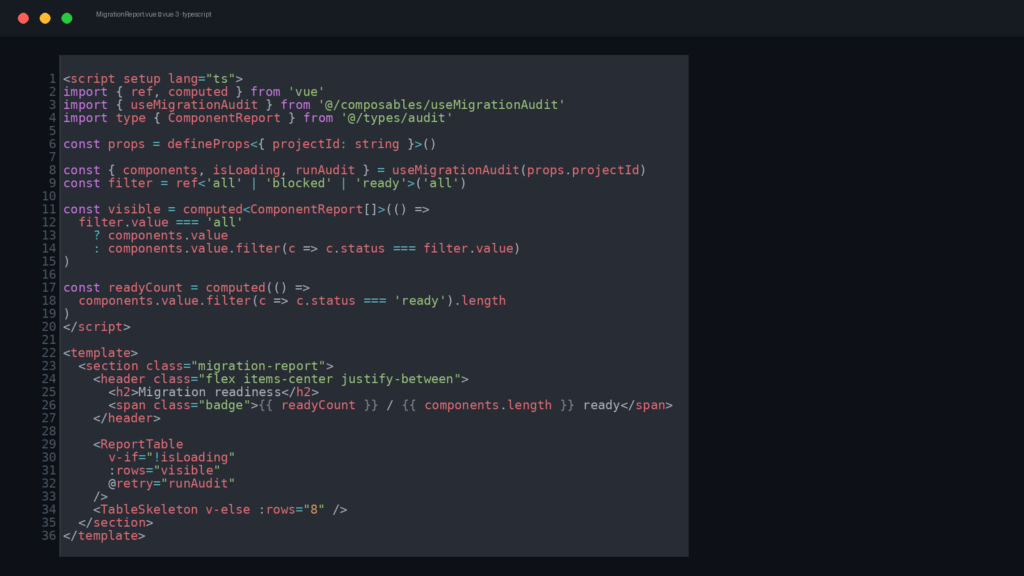
The real problem with hand-written vanilla JavaScript is not the language — it is the missing structure. There is no reactivity, so you sync the DOM by hand and it drifts out of sync. There are no components, so markup and logic get copy-pasted across the app. There are no module boundaries, so any script can touch any global. A vanilla JS to Vue migration replaces manual DOM wiring with a reactive data model, gives you real, reusable components, and adds the TypeScript and tests that make the codebase safe to change.
Technical Audit
Architecture & Plan
Incremental Migration
Hardening & Handover
What a vanilla JS to Vue migration delivers
- Changes stop being a gamble — tested components catch regressions before your customers do
- Additionally, a frontend developers want to work on, not flee from (Vue 3, Vite, TypeScript-ready)
- No feature freeze — meanwhile, the site keeps running
- Finally, documentation and a 30-day technical warranty after go-live
Can you migrate without rewriting everything at once?
Yes — that is the whole point. Because Vue 3 mounts inside your existing pages, features migrate one by one while the rest of the app keeps running as-is.
Our vanilla JS code has no tests or documentation. Is that a problem?
It is the normal starting point. First, the audit reconstructs how the app actually behaves; then I add tests around each feature before it migrates — so nothing silently changes.
How long does a vanilla JS to Vue migration take?
Generally, a typical site or internal tool runs 4-10 weeks, depending on how much logic lives in the frontend. Either way, the audit gives you a concrete estimate up front.
We run an old PHP backend. Does that need to change too?
No. Vue talks to your existing backend as-is — server-rendered pages, AJAX endpoints or templates. In other words, modernizing the backend can come later, if ever.
More Services
Get in touch
Athens, Greece — working remotely with EU & US teams
info@offline-web.com