

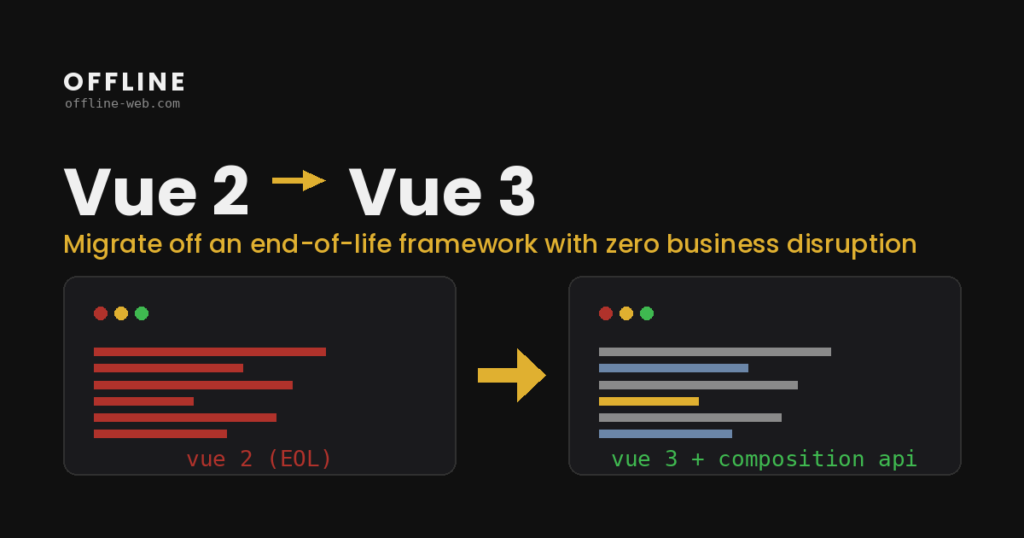
A Vue 3 migration became unavoidable the day Vue 2 reached end of life in December 2023. Since then, there are no security patches, library support keeps shrinking, and every new feature gets harder to ship. The good news, however: it is not a rewrite. Instead, with the right strategy, your app moves to Vue 3 incrementally while your team keeps shipping.
Over the past decade, I have migrated production apps from Vue 2, AngularJS and jQuery to modern Vue 3 with TypeScript and Pinia — for example, OPAP's retail betting machines UI, a business-critical system. Moreover, the approach is always the same: zero business disruption, measurable milestones, and a codebase your team actually wants to work in.
The risks of staying on Vue 2 compound quietly — however, they are real. Every unpatched vulnerability in your dependency chain is now permanent, key libraries such as Vuetify 2 and Vue CLI no longer receive updates, and security reviews increasingly flag end-of-life frameworks. Meanwhile, workarounds accumulate: the longer the upgrade waits, the more expensive it becomes.
What do you gain in return? First, features ship faster and new developers become productive in days instead of weeks. Second, your app stops failing security reviews — the framework under it is supported again, with patches arriving instead of piling up. The tooling behind that (Vite, Pinia, TypeScript) is the proof, not the point. Coming from a different stack? I also handle jQuery to Vue migrations and Nuxt 2 to Nuxt 3 upgrades.
Technical Audit
Architecture & Plan
Incremental Migration
Hardening & Handover
What a Vue 3 migration delivers
- Features ship in days, not weeks — builds and deploys stop being the bottleneck (Vue 3 + Vite)
- Additionally, a codebase new hires can work in from week one (TypeScript, Pinia)
- No feature freeze — meanwhile, the business keeps running
- Finally, documentation, tests and a 30-day warranty after go-live
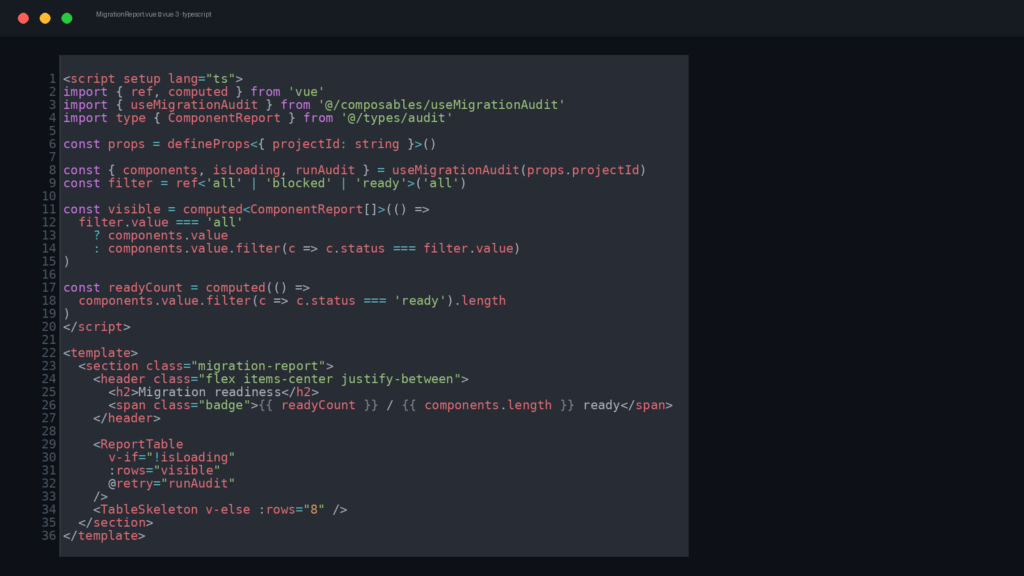
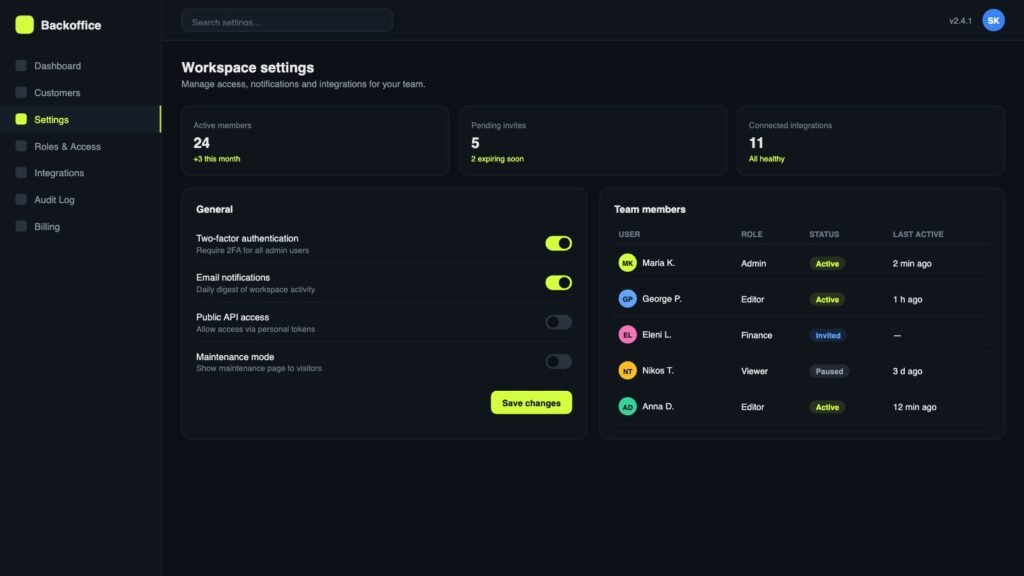
How long does a Vue 2 to Vue 3 migration take?
In most cases, it depends on app size and library debt. For instance, a small-to-mid Vue 3 migration typically takes 4-8 weeks, while larger enterprise apps run in phases. Either way, the technical audit gives you a concrete estimate up front.
Can my team keep shipping features during the migration?
Yes. Because the Vue 3 migration runs incrementally — slice by slice, behind feature flags — the product keeps moving. In other words, zero business disruption is the core constraint of my process.
What about libraries that don't support Vue 3?
First of all, the audit includes a full dependency map. After that, every incompatible library gets a path: an upgrade, a maintained alternative, or a thin replacement component.
Do you also migrate AngularJS or jQuery apps to Vue?
Yes — and the process is the same: audit, architecture, incremental migration. In fact, I have moved AngularJS and jQuery frontends into Vue 3 for clients across the EU and US.
More Services
Get in touch
Athens, Greece — working remotely with EU & US teams
info@offline-web.com